
How to Prepare for IELTS Listening: A Step-by-Step Plan
IELTS Listening plays once. A look at the real SmoothMock test screen, a worked example of a distractor, how to predict answers before the audio starts, the raw scores behind each band, and a weekly routine.
IELTS Listening has 4 parts and 40 questions, and each recording plays once. You can't rewind. If you lose your place during a question, that answer is gone and the audio carries on to the next one. Your preparation should train for that, not for the easier version where you pause and replay.
Most lost marks in Listening come from three situations. You were still writing the last answer when the next one was spoken. The speaker corrected themselves and you wrote the first version. Or you heard the answer correctly and wrote it in a form the question didn't allow. None of these needs more English. All of them can be trained.
This guide is a routine from your first test to the final week. It includes a tour of the real test screen on SmoothMock and a worked example of the most common trap. For one habit that moves scores, see the Listening band 8 habit. This post covers the whole plan.
What the test looks like
From the official test format:
- 4 parts with 10 questions each. Parts 1 and 2 are everyday social situations, and Parts 3 and 4 are educational and training situations.
- You hear the recordings once only, in a mix of accents that includes British, Australian, New Zealand and North American.
- Questions follow the order of the recording, so the answer to question 5 comes before the answer to question 6.
- Question formats are multiple choice, matching, plan/map/diagram labelling, form/note/table/flow chart completion, sentence completion and short answer.
- On completion questions you lose the mark if you write more than the word limit.
- Each correct answer earns 1 mark.
On paper, you get 10 minutes at the end to copy your answers onto the answer sheet. On computer, you get 2 minutes to check your answers instead. SmoothMock follows the computer-delivered format.
Take a full test with one play
Start with a complete test: 4 parts, one pass. SmoothMock lets you replay a recording in practice, but the real exam doesn't, so leave replay alone for your baseline. A replayed baseline hides the weakness you're trying to measure.
On SmoothMock:
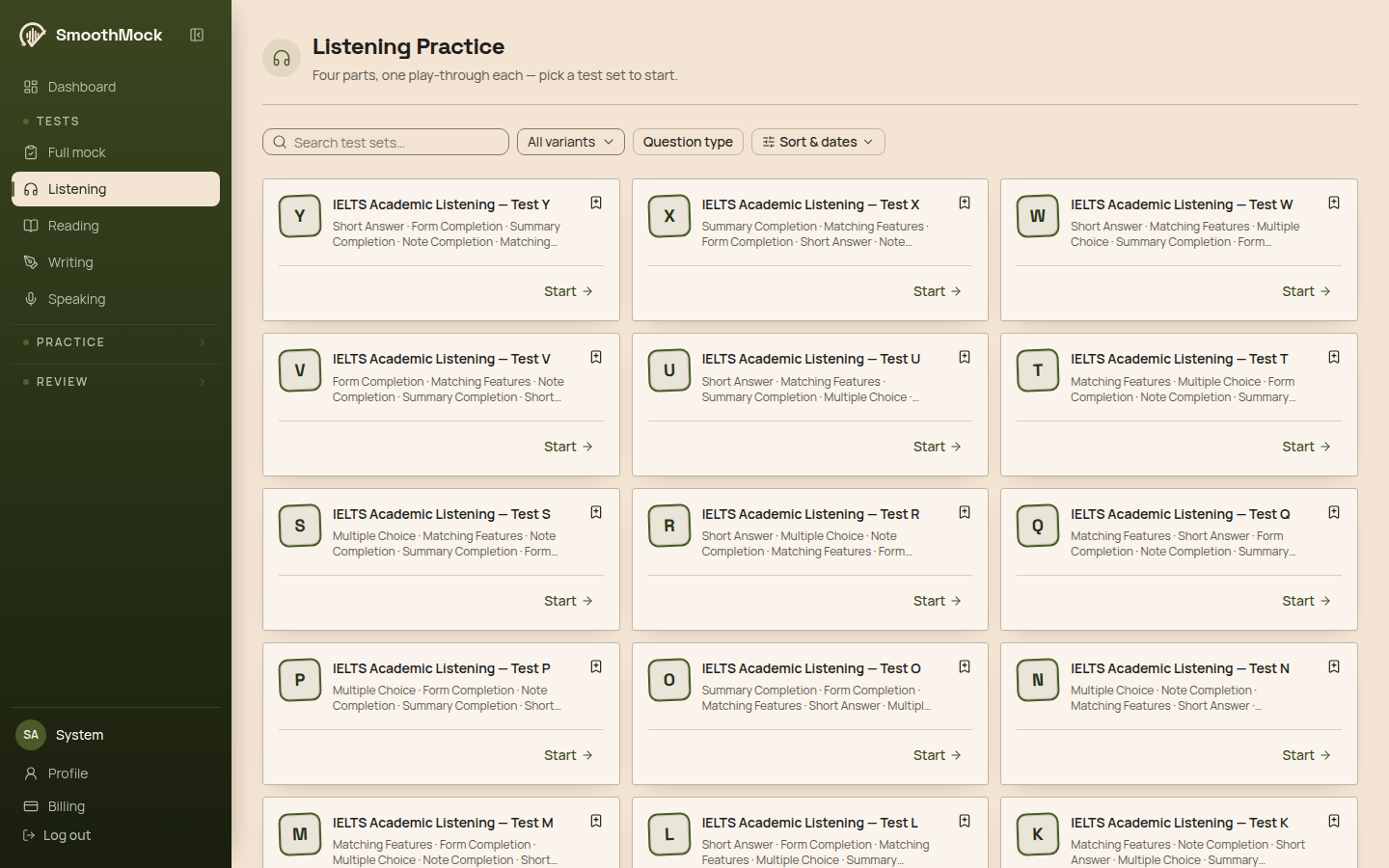
- Open Listening in the left sidebar, under Tests, or start from the public Listening practice test page.
- Pick a test set and press Start.
- Finish all four parts before you look at any result.
Listening is unlimited on every plan, so you can repeat this as often as you want.
The test screen
This is a Listening test open on SmoothMock before any answer has been entered.
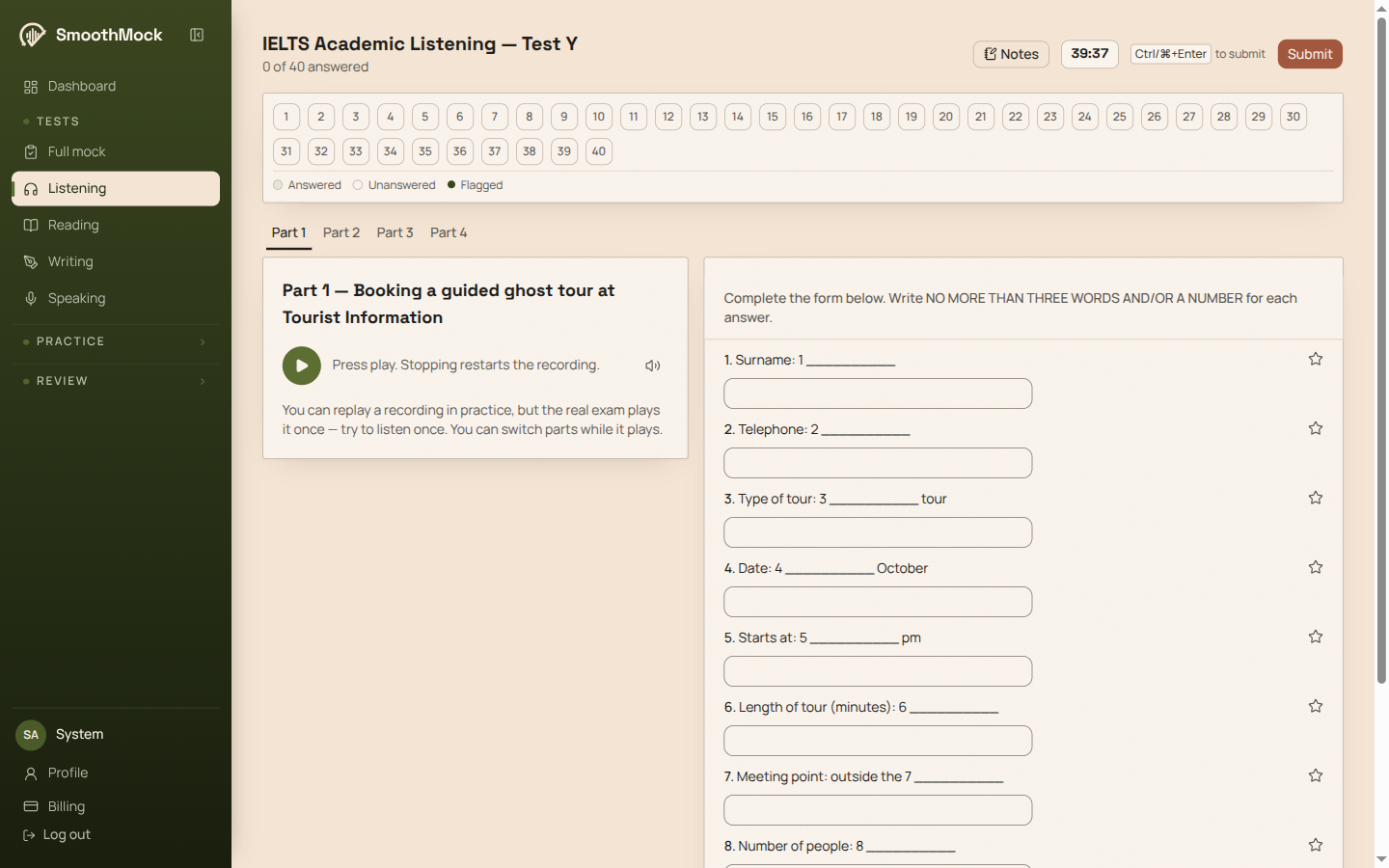
Reading it from the top:
- The header shows the test set's name, how many of the 40 questions you've answered, a Notes button, a countdown timer and a Submit button. Ctrl or Cmd plus Enter also submits, so mind where your fingers are.
- Below it, the question navigator has a numbered button for each of the 40 questions, with a key for Answered, Unanswered and Flagged. Click a number to jump to that question.
- The tabs switch between Part 1 and Part 4. You can switch parts while a recording plays.
- The recording panel has the part's title, a play button and a volume control. The note under it says the real exam plays each recording once and asks you to try to listen once. It also says that stopping restarts the recording, so you can't pause midway.
- The questions come with their instructions, including the word limit, and an answer box each. The star beside a question flags it for review within this attempt.
Before you press Begin listening, a start screen shows the test's time limit, the number of parts, a "Replay allowed" label and a list of what you'll hear. The audio and questions unlock when you begin.
Use the star as you would a pencil mark on paper. Flag a question you guessed or skipped, then use the navigator at the end to go back to it.
How a distractor works
The most common trap in Listening is a speaker who gives one answer and then changes it. Here is an invented Part 1 booking call, for illustration only. It isn't from a real test.
Receptionist: So I can put you down for Wednesday morning.
Caller: Wednesday is fine, although actually, I have a meeting then. Could we do Thursday instead?
Receptionist: Thursday at ten is free.
Caller: Perfect, Thursday at ten, then.
The form says: Appointment day: ______
A candidate who writes the first thing they hear puts "Wednesday". The answer is "Thursday". The wrong answer came first and sounded confident, and the correction arrived after "although actually".
A few things help:
- Signal words such as "although", "actually", "instead", "but" and "however" often mark a change. When you hear one, stop trusting what you've written and listen to what follows.
- A confirmed detail often counts. Here the last line repeats "Thursday at ten".
- Write lightly. Pencil in a first answer if you need to, but be ready to replace it.
Distractors turn up in multiple choice too. A speaker may mention every option in turn and endorse only one, so listen for the one they agree with, not the one they mention first or most often.
Predict the answer before the audio starts
You get a short time to read the questions before each recording. Most candidates re-read the questions. A better use is to predict what kind of answer each gap needs.
Look at each gap or option and ask whether it's a number, a name, a day, a place, an adjective or a reason. Underline the keywords and note the word limit. In the booking call, "Appointment day" tells you the answer is one of seven days, which makes "Thursday" much easier to catch than if you were listening for anything at all.
Use that time to check the order, too. Answers come in the order of the recording, so if you know what the questions before and after look like, you'll notice when the speaker has moved on. A heading in a table often tells you the topic the speaker is about to discuss.
What to do when you lose your place
It will happen. You're still writing question 6 and the speaker is already on question 7. The usual reaction is to keep trying to finish question 6, and then you miss 7 and 8 as well.
Drop the lost answer and re-anchor on the next question's keywords. Losing one mark is better than losing three. At the end, in the 2 minutes on computer or the transfer time on paper, make an educated guess for the one you dropped. Answers follow the recording order, so the words around the gap often point to something reasonable.
How each part differs
The parts get harder as the test goes on, and each rewards a slightly different habit.
Part 1 is a conversation in an everyday setting, such as booking a service. It's full of names, numbers and dates, so accuracy matters most. Names are often spelled out letter by letter, so be ready to write them exactly.
Part 2 is a monologue in an everyday setting, such as a talk about facilities. Many questions here are map, plan or diagram labelling. Keep your finger on the map and follow the speaker's direction words, such as "opposite", "next to" and "behind".
Part 3 is a conversation between up to four people in an educational setting. With several speakers, it matters who holds which opinion, so note who says what. Disagreement is common: one speaker proposes an idea and another rejects it.
Part 4 is a monologue on an academic subject, such as a university lecture. There's one speaker and no break, so listen for signposting like "firstly", "another factor" and "to sum up" to keep track of where you are.
If your score drops sharply in Part 3 or 4, that tells you where the next two weeks should go.
Read your result and learn the band targets
A score out of 40 is converted to a band. These are the reference points published by IELTS and IDP:
| Raw score (of 40) | Band |
|---|---|
| 16 | 5 |
| 23 | 6 |
| 30 | 7 |
| 35 | 8 |
Each figure is the number of marks needed to reach that band. IELTS says the exact number varies slightly between test versions, so don't treat any figure as exact. Unofficial sites list ranges such as 30 to 31 for Band 7, but only the single figures above come from the test owners. The band score calculator shows how your Listening score combines with the other three sections.
On SmoothMock, the result page opens with a "What to do next" panel naming the question type you missed most. Wrong answers are tagged with a "Why" that sorts the mistake into one of six causes: distractor traps, vocabulary gaps, grammar errors, missed paraphrases, careless or time-pressure slips, and off-topic answers. In Listening, the usual patterns are:
- Distractor traps: the speaker mentions an option, then corrects themselves, as in the booking call. The word after "but" or "however" is usually the answer.
- Vocabulary gaps: when the audio moves fast, catch the stressed words, meaning nouns, verbs and numbers. They carry the answer even when the small words blur.
- Missed paraphrases: answers in a recording almost never repeat the question's words, so listen for phrases with the same meaning.
Answer-writing rules can also cost marks you actually earned by hearing correctly. IELTS says you lose the mark if you go over the word limit. Writing a word where the form needs a number is wrong too. Before each recording, read the word limit for each question set, and at the end, use the checking time for spelling and for any gap you left blank.
Drill question types in isolation
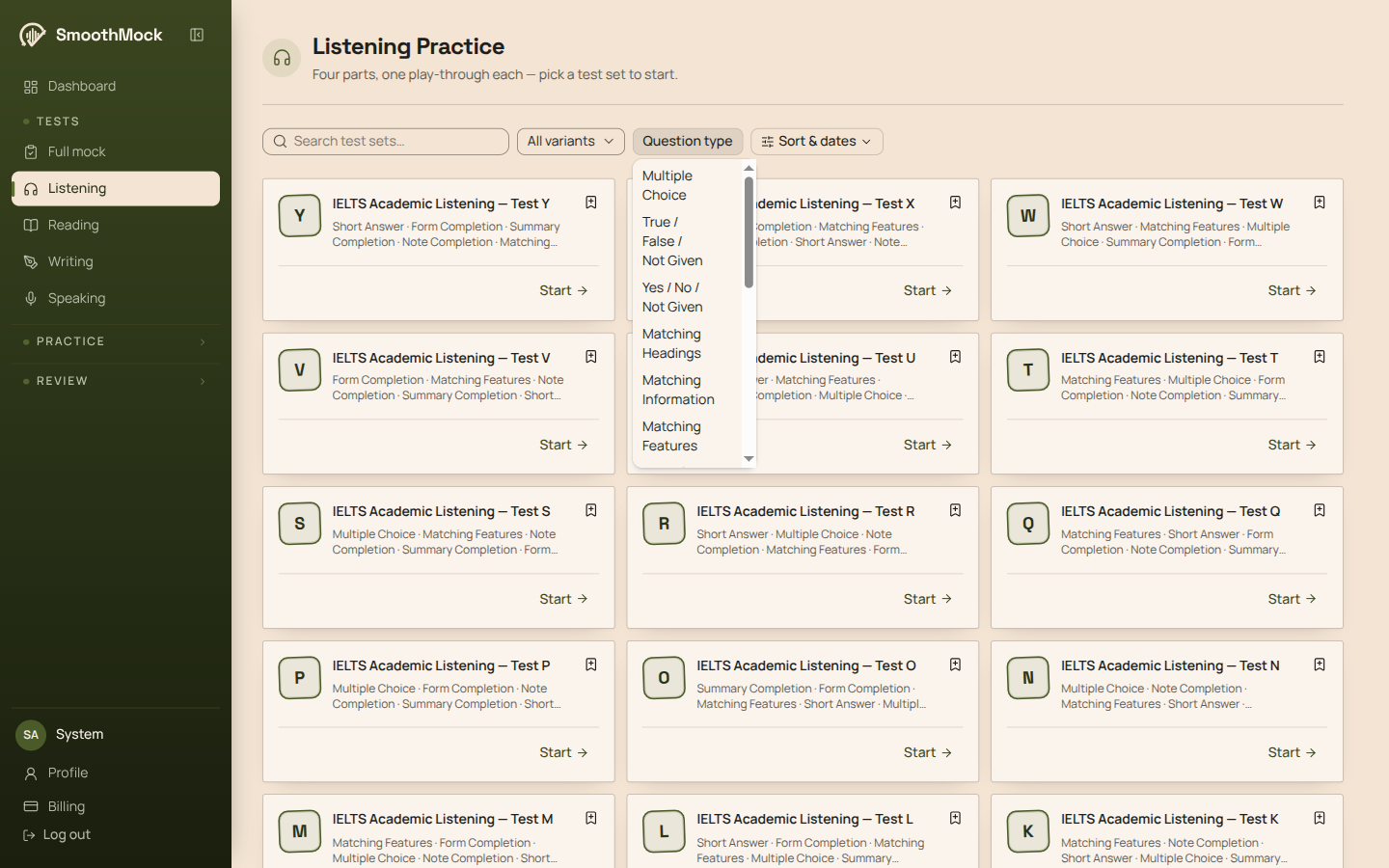
Back on the Listening page, the Question type filter lists the formats, such as multiple choice, matching headings and matching information, so you can find test sets that include your weakest type.
For focused practice on one format, open Drills in the sidebar, under Practice. Drills are grouped by what the question asks you to do: completion, matching, choose or decide, and labelling. Each one covers a single question type, gives feedback after every answer and has no timer, so you can slow down and see why an answer was right.
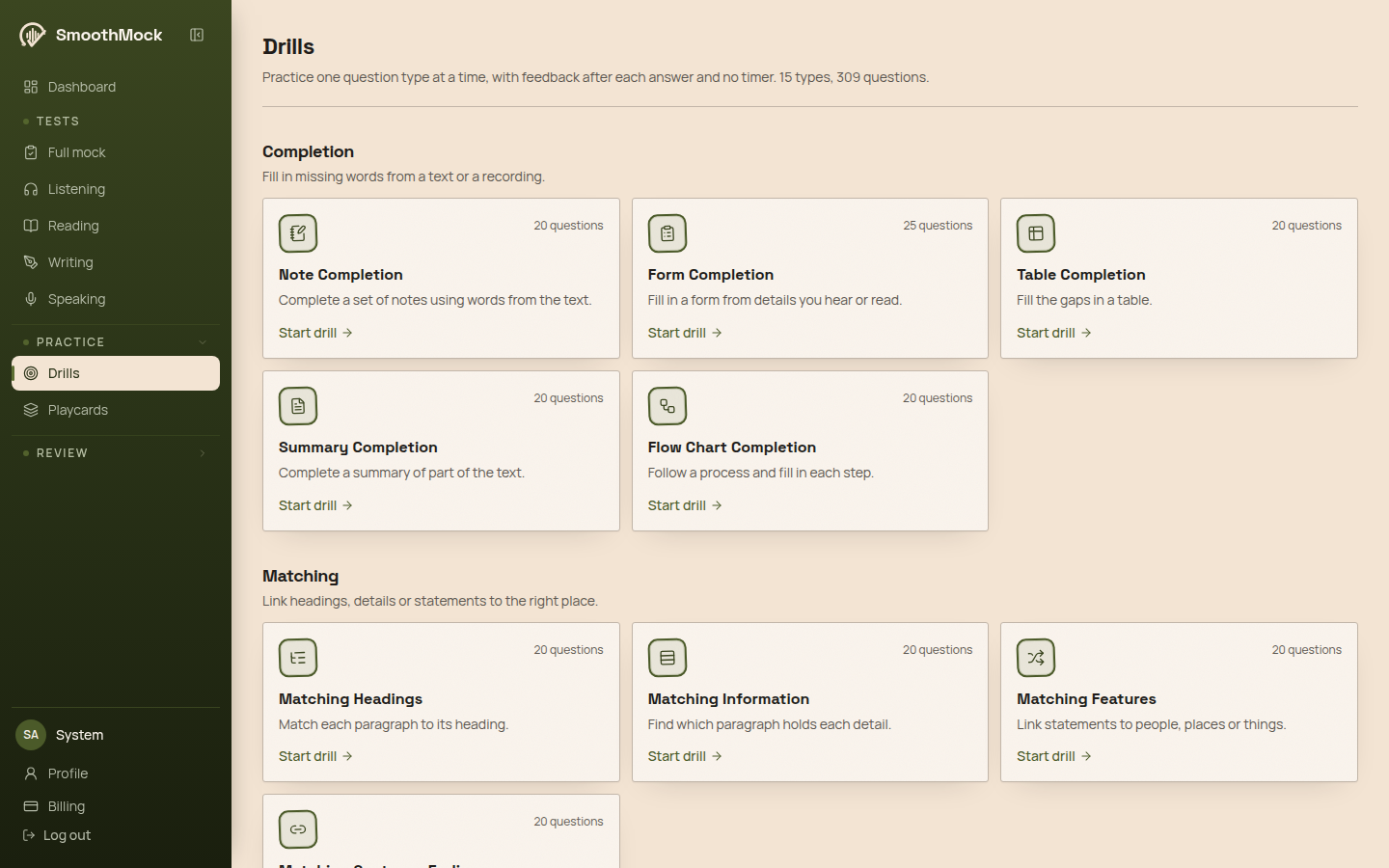
After each drill, go through every wrong answer and ask whether you didn't hear it, heard it but wrote it wrong, or heard it and got pulled away by a distractor. Not hearing it is a listening and vocabulary problem. Writing it wrong is a technique problem, so practise the word-limit and form rules. Getting pulled away is the distractor problem from the worked example.
Check Graded papers for repeat mistakes
After a few tests, open Graded papers in the sidebar, under Review. The "Where you lose marks" section ranks the causes behind your lost marks, most frequent first. Each has a "How to fix this" note and a "Practice this" link, which for Listening takes you to Drills. Take the cause at the top and work on it for a week before you move to the next one.
A weekly routine
- Two days: a 15-minute drill on your weakest question type, then review.
- Two days: one recording from a full test under one-play rules, then review it with the distractor questions in mind.
- One day: a drill on your second weakest type.
- Weekend: a full test, then compare the question-type breakdown with last week's.
Short, frequent sessions usually work better than one long weekend session, because you're training attention. If you're also working on the other skills, the matching guides are Reading, Writing and Speaking.
Frequently Asked Questions
Does the audio play more than once?
No. IELTS plays the recordings once only. In SmoothMock's practice you can replay a recording, but you're asked to listen once, and stopping restarts the recording instead of pausing it.
How many questions are in IELTS Listening?
There are 40 questions, 10 in each of 4 parts.
How many correct answers do I need for Band 7?
About 30 out of 40 on average, and about 35 for Band 8, according to IELTS and IDP. The exact number varies by test.
How is computer-delivered Listening different from paper-based?
The recordings and questions are the same. The difference is at the end: 2 minutes to check your answers on computer, or 10 minutes to copy them onto the answer sheet on paper.
What should I do if I miss an answer?
Let it go and move to the next question. Answers follow the order of the recording, so chasing one can cost you the next two or three.
Can I practice Listening for free?
Listening is unlimited on every plan on SmoothMock. Writing and Speaking have free-plan limits, but Listening and Reading do not.
Sources
- IELTS Academic Listening format (ielts.org)
- How IELTS is scored in detail (ielts.org)
- IELTS Listening band scores (IDP)
- IELTS on computer and on paper (IDP)
Facts about the test format and scoring were checked against these sources on 1 October 2026. The sample conversation in the distractor section is invented for illustration, and the advice on technique is the author's own.
Ready for a baseline? Take the Listening practice test, then come back to the band targets.
Ready to put this into practice?
Start a free full-length IELTS mock test — AI graded in minutes.
Start your free test →