
How to Prepare for IELTS Speaking: A Step-by-Step Plan
A worked Part 2 answer, a pattern for Part 3 follow-up questions, how to review your own transcript, and a weekly routine using SmoothMock's Speaking practice and the cue card generator.
IELTS Speaking takes 11 to 14 minutes. It's the shortest section, and the one candidates feel least sure about afterwards. A poor start is hard to recover from in that time, and a memorised answer helps less than you'd expect, because the examiner is scoring how you build English on the spot.
Speaking does respond well to practice aimed at specific habits: how you start an answer, how long you can keep going, how you give a reason. This guide covers those habits with worked examples, then shows how to review your own recordings and how to spread SmoothMock's Speaking practice and the cue card generator across a week. For question ideas, see IELTS Speaking topics for 2026.
What the test looks like
From the official test format, Speaking is an interview with an examiner in three parts:
- Part 1, Introduction and interview (4 to 5 minutes): the examiner checks your identity and asks general questions about familiar topics such as home, family, work, studies or interests.
- Part 2, Long turn (3 to 4 minutes including preparation): you get a task card, one minute to prepare notes on paper, then speak for about two minutes. The examiner may ask one or two follow-up questions.
- Part 3, Discussion (4 to 5 minutes): you discuss issues related to the Part 2 topic in a more general and abstract way.
Your band is scored on four criteria, each with equal weight:
- Fluency and coherence: speaking at normal speed, with logical organisation and linking words.
- Lexical resource: range of vocabulary and accurate use, including alternative ways to say something.
- Grammatical range and accuracy: variety and correct use of grammar structures.
- Pronunciation: speaking in a way that can be understood without too much effort.
Because the four criteria weigh the same, one weak area drags the band down however strong the other three are. Good vocabulary can't make up for weak grammar.
Do a first session out loud
Take a full session before you study anything. You want a baseline of how you speak with no preparation.
On SmoothMock:
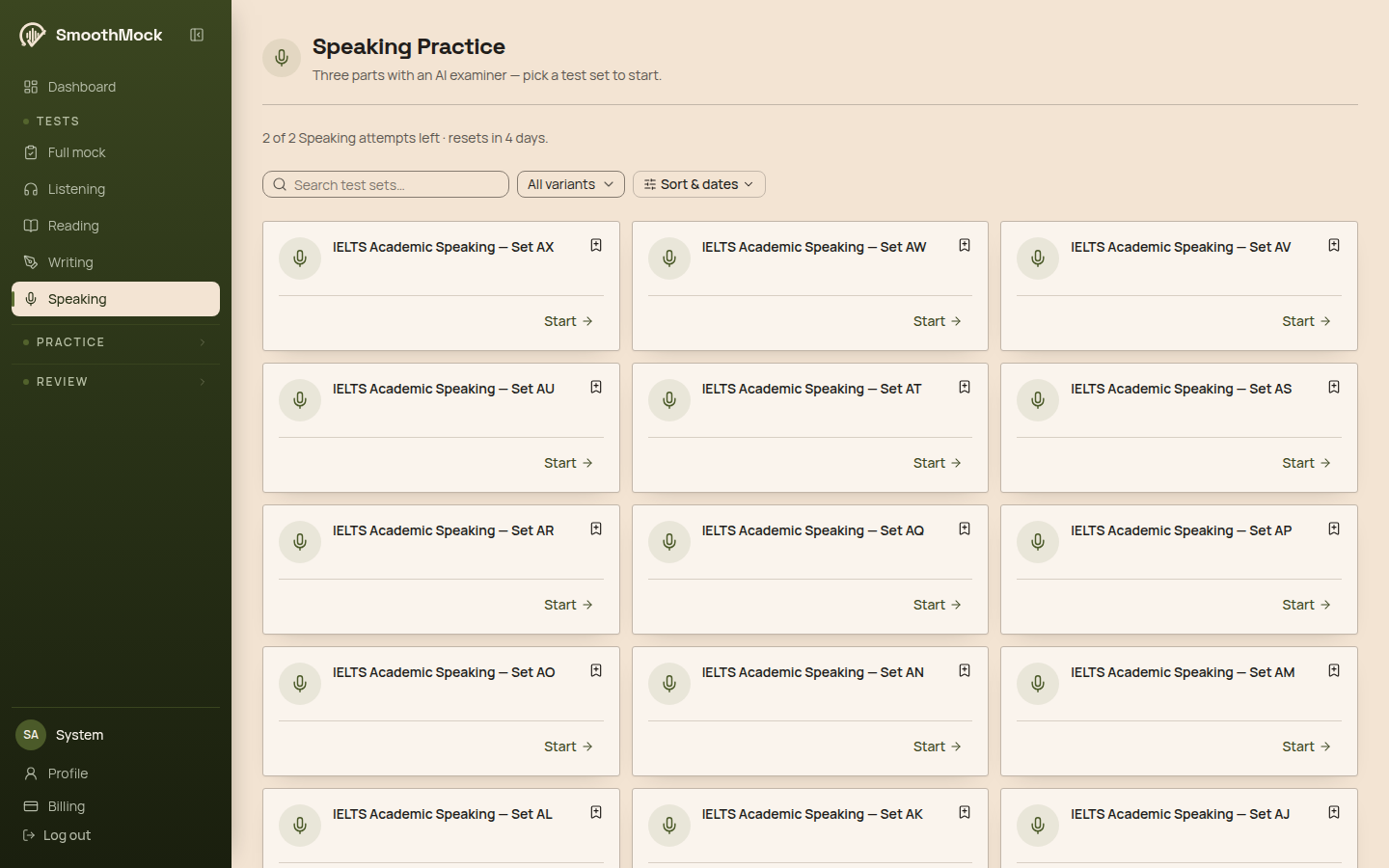
- Open Speaking in the left sidebar, under Tests, or start from the public Speaking practice test page.
- Pick a test set and press Start. Allow microphone access when your browser asks. The test works on a phone as well as a laptop.
- Answer in the three-part flow: introduction questions, a timed cue card, then a discussion.
The free plan gives you 2 Speaking sessions a week, so a session you don't review is wasted. Paid plans raise that limit.
Make Part 1 answers longer than one sentence
Part 1 questions sound easy, so candidates answer in one clause and wait. "Do you prefer buying things in shops or online?" gets "Online." That isn't wrong, but it shows no range, and range is what's being scored.
A simple pattern is answer, reason, example. Compare:
Online. It's easier.
with
I mostly buy online, mainly because I can compare prices without leaving the house. Last month I bought a pair of headphones that way and saved quite a bit over the shop price.
The second answer is three sentences and takes under ten seconds. It has a direct answer, a reason and a small example, which gives the examiner something to assess. Part 1 doesn't need long answers, only answers that aren't bare. Practise by taking any Part 1 question and answering in three short sentences.
Learn the shape of a Part 2 answer
Part 2 is where most candidates stall. If you've only practised short answers, you'll probably run out of things to say around the 45-second mark, then repeat yourself or go quiet.
Here is a prompt from our Speaking practice page:
Describe a skill you would like to learn. You should say what it is, why you want to learn it, and how you would learn it.
Use the preparation minute for keywords, not sentences. A workable set of notes:
- Skill: playing the guitar.
- Why: relax after work, always liked the sound.
- How: online lessons, 20 minutes a day, a friend who plays.
- Feeling: nervous, but excited.
Then speak in order, using the card's bullet points as your outline, since they tell you what the examiner expects to hear. Say what it is, with one detail that makes it specific. Give the reason, then a small story or example that shows it. Explain how you'd learn it, with real steps. Finish with how you feel about it, and stop there instead of trailing off.
These notes are an invented example for illustration, so don't memorise them. The card gives you a ready-made outline, and following it means you rarely run dry. If you finish the bullets early, add a detail to the one you know best, such as a specific moment or a comparison, instead of repeating yourself.
Answer Part 3 with a view, a reason and an example
Part 3 questions ask you to compare, speculate and evaluate: "Do you think it's important to learn skills throughout your life, not just when you're young?" A one-line opinion usually draws a follow-up such as "Why do you think that?" or "Can you give me an example?"
Answer the follow-up before it's asked by building it into the first answer:
I think it is, because jobs change faster now than they used to. For example, many people I know have had to learn new software just to keep doing the same role.
That's a view, a reason and an example in two sentences. You can extend it with a contrast: "That said, for some people it's harder, especially if they have little free time." The contrast shows you can weigh both sides, which is the point of Part 3.
If a question is hard, buy time with a short opener such as "That's an interesting question, I'd say..." and use the pause to pick your view. One opener is fine. If every answer starts the same way, the examiner will hear the pattern.
Review your own transcript
After a session is marked on SmoothMock, open the result. It shows your band, the four criterion scores (fluency and coherence, lexical resource, grammatical range and pronunciation), a written feedback note and an interview transcript, so you can read what you actually said.
Start with the lowest criterion, since that's this week's target. Read the transcript with that criterion in mind, looking for fillers such as "um" and "like", words you repeat and sentences that stop halfway. Pick one specific pattern to change, for example "stop starting every answer with 'I think'", write it down, and do the next session with only that in mind.
Fixing one pattern a week beats trying to fix everything. Reading a transcript is also different from hearing yourself: repeated words and unfinished sentences are much easier to spot on the page.
Train Part 2 on its own
A full session uses one of your two free sessions a week, so build the long-turn skill separately. The cue card generator is free and has 208 Part 2 topics. Press New topic to draw one, and it runs the real timing: one minute to prepare and two minutes to speak. If you tick the option to record your answer, you can listen back straight away. The recording stays in your browser and isn't uploaded.
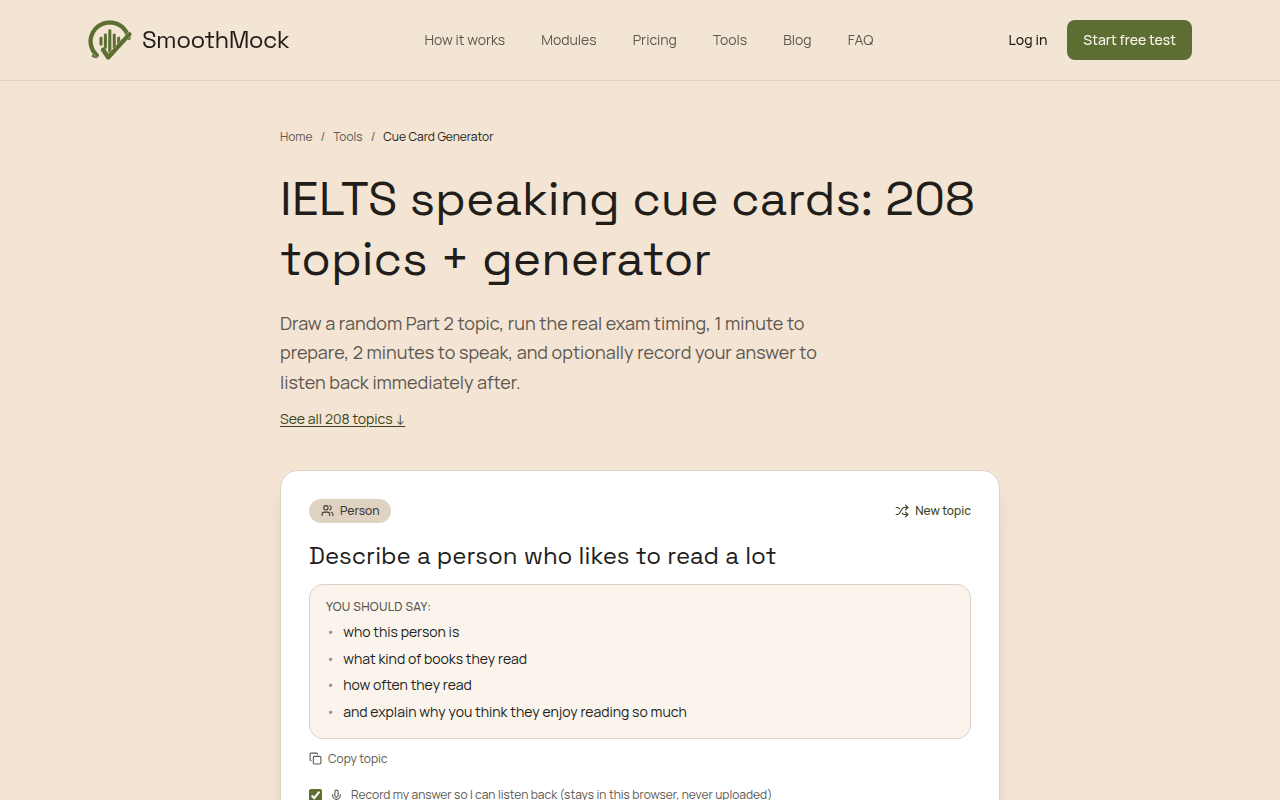
Take a card, prepare, speak, then listen back once. Note where you stopped, where you repeated yourself and where you could have added a detail. Three of these a week, at about five minutes each, won't touch your session allowance. For Part 1 and Part 3, take questions from the Speaking topics post and answer out loud with a timer.
Check Graded papers for repeat patterns
After a few sessions, open Graded papers in the sidebar, under Review. The "Where you lose marks" section ranks the causes behind your lost marks across papers, most frequent first, with a "How to fix this" note for each. For Speaking, "Practice this" takes you to the Speaking test page, because Speaking has no separate drills. If the same cause keeps ranking first, give it your whole week.
A weekly routine
- Two full sessions on SmoothMock if you're on the free plan, each followed by a read of the four criteria and the transcript.
- Three short solo recordings of Part 2 on the cue card generator, about two minutes each, listened back.
- A handful of Part 3 questions answered out loud with the view, reason and example pattern.
- One focus point for the week, taken from your lowest criterion.
The solo recordings are free and don't use your weekly allowance, so they fill the days between sessions. To see how your Speaking band fits with the other three sections, use the band score calculator. The overall band is the average of the four, rounded to the nearest half band. If you're working on the other skills too, the matching guides are Reading, Listening and Writing.
Frequently Asked Questions
How long is the IELTS Speaking test?
11 to 14 minutes in three parts: introduction and interview, a long turn on a task card, and a discussion.
How is IELTS Speaking scored?
On four equally weighted criteria: fluency and coherence, lexical resource, grammatical range and accuracy, and pronunciation.
How many Speaking sessions do I get on SmoothMock?
Two a week on the free plan, and more on paid plans.
Do I get time to prepare for Part 2?
Yes. You get one minute and a pencil and paper to jot notes, then you speak for about two minutes.
How can I practice Part 2 without using a session?
Use the cue card generator with a timer and record yourself.
Can I practice Speaking on my phone?
Yes. The speaking flow works on a phone with microphone access.
Sources
Facts about the test format and scoring were checked against these sources on 1 October 2026. The sample answers and notes are invented for illustration, and the advice on answer structure is the author's own.
Ready for a baseline? Take the Speaking practice test, then come back to the transcript review.
Ready to put this into practice?
Start a free full-length IELTS mock test — AI graded in minutes.
Start your free test →