
How to Prepare for IELTS Writing: A Step-by-Step Plan
A worked Task 2 plan and Task 1 overview, how the four criteria mark your essay, how to turn repeat errors into a checklist, and a routine for using SmoothMock's Writing practice without wasting attempts.
IELTS Writing is two tasks in 60 minutes, and for many candidates it's the section that holds the overall band down. The usual cause isn't weak English. People write essay after essay without learning what's wrong with the last one, so the same errors come back every time.
That splits into two problems. One is what to write: how to plan a Task 2 essay in five minutes and how to open a Task 1 report. The other is how to improve: where to find feedback and how to turn it into something you use in the next attempt. This guide covers both with a worked example of each, and points to where each step lives on SmoothMock. For topics to practise on, see IELTS Writing topics for 2026.
What the test looks like
From the official test format:
- Task 1: describe visual information (a graph, table, chart or diagram) in your own words. At least 150 words in about 20 minutes.
- Task 2: discuss a point of view, argument or problem. At least 250 words in about 40 minutes.
- Task 2 contributes twice as much as Task 1 to your Writing score.
- You write in full sentences, not notes or bullet points. Plagiarised or irrelevant content is penalised.
Both tasks are marked on four criteria, weighted equally: task achievement (Task 1) or task response (Task 2), coherence and cohesion, lexical resource, and grammatical range and accuracy. The first criterion includes whether your answer is long enough, so a response well under the minimum loses marks there.
Since Task 2 counts double, an extra 20 minutes on Task 2 essays will usually move your Writing band more than the same time on Task 1.
Write a timed baseline
Do a full attempt before you study anything: Task 1 and Task 2 back to back, timed, no pausing. Planning ahead would hide how you write with the clock running.
On SmoothMock:
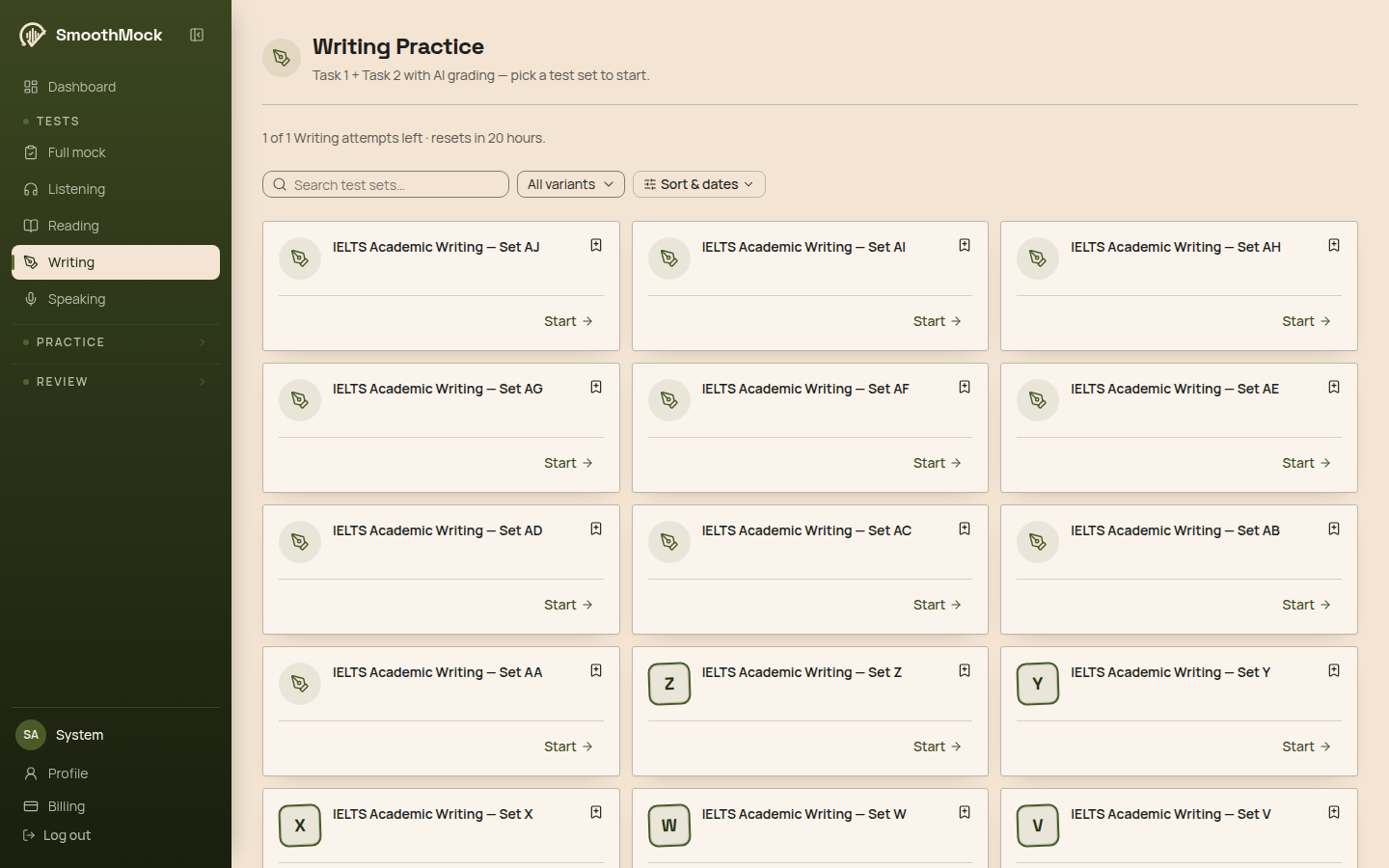
- Open Writing in the left sidebar, under Tests, or start from the public Writing practice test page.
- Pick a test set and press Start.
- Write both tasks without stopping to look anything up.
The free plan gives you one Writing attempt a day, so each one deserves a proper review. Paid plans raise that limit.
Plan a Task 2 essay in five minutes
Most low Task 2 essays aren't badly written. They answer a slightly different question from the one that was asked, and a five-minute plan prevents that.
Here is a prompt from our Writing practice page:
Some people believe that unpaid community service should be a compulsory part of high school education. To what extent do you agree or disagree?
A workable plan has four lines:
- Position: mostly agree, with a condition. Community service should be required, but schools should let students choose the kind.
- Body paragraph 1, the main reason: it builds practical skills and awareness of local problems. Example: a student who volunteers at a food bank sees how supply and demand work outside a textbook.
- Body paragraph 2, the counterargument: compulsion can create resentment. Response: letting students choose reduces that risk.
- Conclusion: restate the position, with the condition, in a sentence or two.
I wrote this plan for illustration, so don't memorise it. What matters is its shape: a clear answer to "to what extent", two paragraphs that each do one job, and an example in each. Planning like this keeps you on topic, and staying on topic is what task response measures.
Underline the exact words of the question and check that your position answers them. "To what extent do you agree or disagree" asks for a degree of agreement, not a list of pros and cons.
Open a Task 1 report with an overview
In Task 1, the most common loss is describing every number and never saying what the data shows overall. An overview sentence fixes that. Here is an invented example, for illustration only:
A chart shows the percentage of households with internet access in three countries between 2000 and 2020.
A weak opening lists the first number for each country. A stronger one gives the overall picture first:
Overall, internet access rose in all three countries over the period, with Country A consistently highest and Country C showing the steepest growth.
After the overview, group the data. Describe the highest and lowest values and the main changes in separate paragraphs instead of walking through every year in order. Choose the features that matter and leave the rest out. A report that mentions every data point in sequence usually runs out of time and shows no analysis.
Read your score by criterion
After marking on SmoothMock, open the result. Each task shows its own band, then the four criterion scores: task achievement, coherence and cohesion, lexical resource and grammatical range. A written feedback note sits under them.
Find the lowest criterion in each task. That's your target, not the overall band. The usual reasons for a low score:
- Task achievement: you didn't answer every part of the question, or your examples are thin. In Task 1, you listed numbers without picking out the main trend.
- Coherence and cohesion: ideas come in the wrong order, or every sentence is linked with the same two connectors.
- Lexical resource: the same words repeat, or advanced words are used incorrectly.
- Grammatical range: every sentence has the same structure, or small errors repeat.
Choose one criterion to work on this week.
Track the mistakes that repeat
One essay tells you what happened once. Three essays show what you do every time. Open Graded papers in the sidebar, under Review. The "Where you lose marks" section groups your lost marks by cause across papers and ranks them, most frequent first. The six causes are distractor traps, vocabulary gaps, grammar errors, missed paraphrases, careless or time-pressure slips, and off-topic answers. Each has a "How to fix this" note.
For Writing, the ones that matter most are usually grammar errors, vocabulary gaps and off-topic answers. Turn your top one into a rule you can check before you stop writing, such as:
- "Check every uncountable noun for a stray plural s."
- "Re-read the question and check every paragraph answers it."
- "Replace the word I used three times in this paragraph."
A checklist you actually use beats a grammar chapter you read once. Keep it short, because a long list won't get used.
Budget your 60 minutes
Sixty minutes is tight for two tasks. One way to split it:
- Task 1: 3 minutes planning, 14 writing, 3 checking.
- Task 2: 5 minutes planning, 30 writing, 5 checking.
That's a starting point, not a rule. Try it on two attempts and adjust. The common failure is spending too long on Task 1 and starving Task 2, the task that counts double.
Aim past the minimum
IELTS sets the minimums at 150 words for Task 1 and 250 for Task 2, and the first criterion includes whether you wrote enough. Counting by hand wastes minutes, so use the word counter and task checklist until you can feel the length. It's free and needs no account. Switch between Task 1 and Task 2 and it shows the minimum that applies (250 words for Task 2) and counts as you type. A response sitting just at the limit has little room to develop ideas, so aim a little past it.
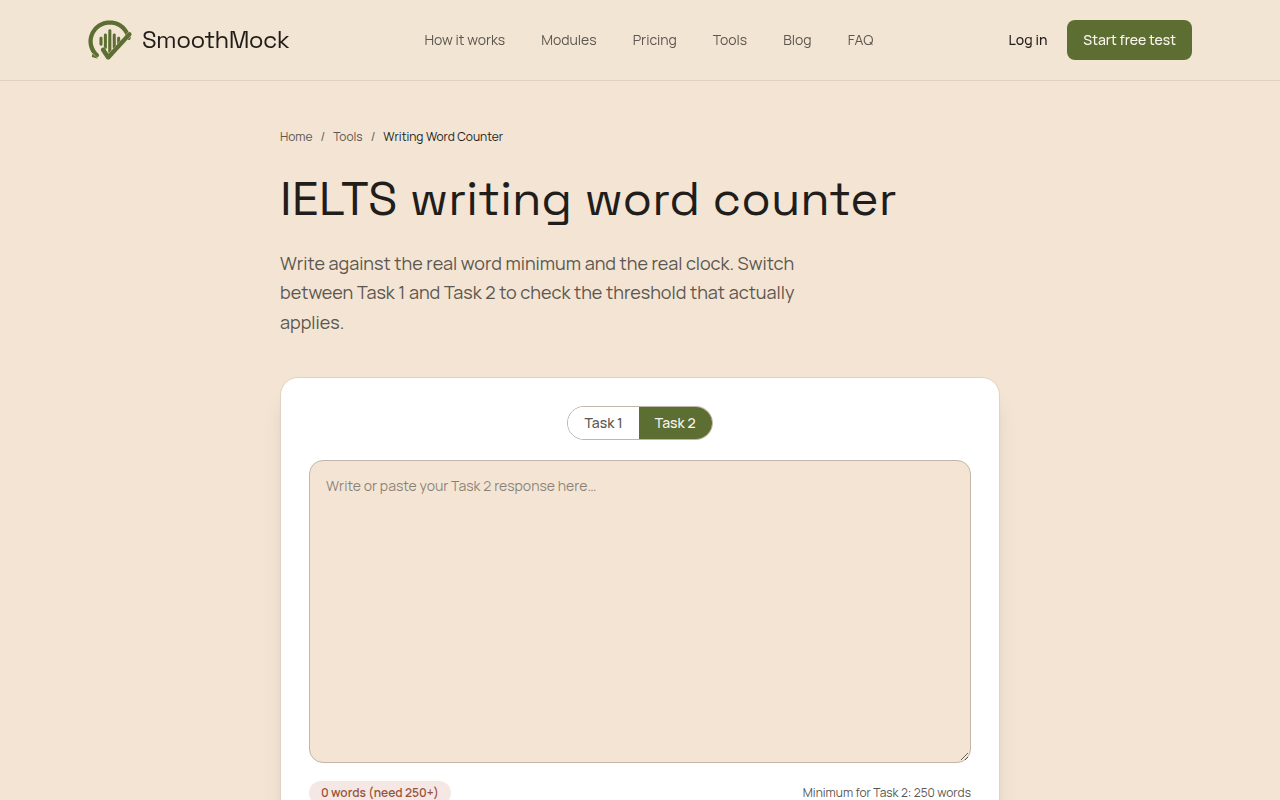
The counter suits planning drills and rewrites, which don't use up a daily SmoothMock attempt. Keep your graded attempt for a full timed task.
Rewrite, don't just write more
Ten essays you never review are worth less than three you rewrite. After an attempt, take the paragraph that scored lowest and rewrite it against your checklist, then compare the two versions. Most candidates skip this step, and it's where the improvement happens.
One way to do it: copy your weakest paragraph, mark each sentence with the criterion it hurts, rewrite only those sentences and leave the rest alone. You'll see exactly which changes lift the paragraph.
A weekly routine
- Two Task 2 essays, each followed by a review of the criterion scores and the feedback note.
- One Task 1 response.
- One rewrite of your weakest paragraph from last week.
- A look at Graded papers to see whether your top mistake has changed.
Writing is capped on the free plan, so decide which days you write and use the other days for planning practice and rewrites, which don't need an attempt. You can practise the Task 2 plan and the Task 1 overview with a notebook and a timer: take any past prompt, plan it in five minutes and compare the plan with a friend's or a teacher's.
The band score calculator shows how your Writing band combines with the other three sections. The overall band is the average of the four, rounded to the nearest half band. If you're working on the other skills too, the matching guides are Reading, Listening and Speaking.
Frequently Asked Questions
How much does Task 2 count toward the Writing band?
It counts twice as much as Task 1, so extra practice time goes furthest on Task 2 essays.
What's the minimum word count for IELTS Writing?
At least 150 words for Task 1 and at least 250 for Task 2. The task achievement or response criterion includes whether you wrote enough.
How long do I get for each task?
About 20 minutes for Task 1 and about 40 minutes for Task 2, within 60 minutes in total.
What should I write first in Task 1?
A short overview that says what the data shows overall, before any detail.
How many Writing attempts do I get on SmoothMock?
One a day on the free plan, and more on paid plans.
What do the four criteria measure?
Whether you answered the task and wrote enough, how clearly your ideas are organised, the range and accuracy of your vocabulary, and the range and accuracy of your grammar. Each is weighted equally.
Sources
Facts about the test format and scoring were checked against these sources on 1 October 2026. The essay plan and the Task 1 example are invented for illustration, and the advice on planning and timing is the author's own.
Ready for your baseline? Take the Writing practice test, then come back to the criterion scores.
Ready to put this into practice?
Start a free full-length IELTS mock test — AI graded in minutes.
Start your free test →