
How to Prepare for IELTS Reading: A Step-by-Step Plan
A practical routine for IELTS Reading: a worked example of finding answers fast, how True/False/Not Given and matching headings go wrong, the raw score you need for your band, and how to use SmoothMock to find your weak question types.
IELTS Reading gives you 3 passages, 40 questions and 60 minutes. The 60 minutes include writing your answers down, so nothing is left at the end for copying. That works out to 1.5 minutes per question, and the reading has to fit inside it.
This is why reading more English only gets you part of the way. A strong reader who starts at the top of each passage and reads every word will often reach the third passage with ten questions left. The test rewards a narrower skill: working out where an answer sits, then reading only that part closely.
This guide is a routine from your first timed paper to the week before the exam. It has one worked example of the technique, a look at how each question type goes wrong, the raw scores behind each band, and where to find your weak spots on SmoothMock. For a shorter take on the same technique, see our Band 8+ Reading strategy.
What the test looks like
The official format, so you can check your practice against it:
- 3 sections, 2,150 to 2,750 words in total, 40 questions, 60 minutes.
- Academic texts come from books, journals, magazines, newspapers and online sources, written for non-specialists.
- 11 question types: multiple choice, True/False/Not Given, Yes/No/Not Given, matching information, matching headings, matching features, matching sentence endings, sentence completion, summary/table/flow chart completion, diagram labels and short answer.
- Each correct answer earns 1 mark, and your raw score out of 40 is converted to a band.
Only correct answers score, so a blank and a wrong answer are worth the same. Never leave a question empty.
Start with one timed paper
Take a full paper under exam conditions: 60 minutes, one sitting, no dictionary, no pausing. Don't prepare for it. You want a baseline, because a plan built on a guess about your weak spots usually wastes weeks.
On SmoothMock:
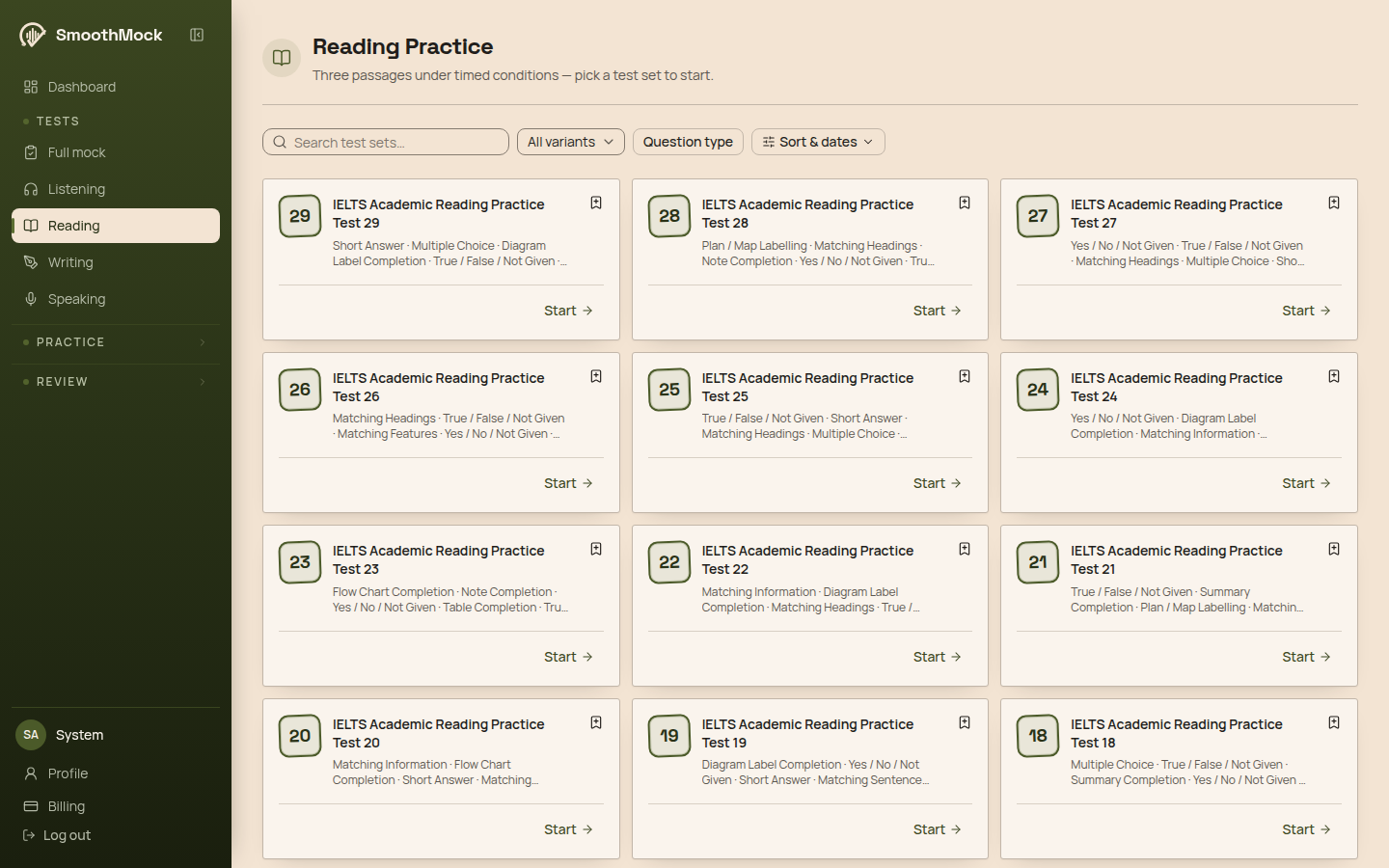
- Sign in and open Reading in the left sidebar, under Tests. You can also start from the public Reading practice test page.
- Pick a test set and press Start. You can search and filter the list if you want a specific variant.
- Finish all three passages before you check anything.
Reading is unlimited on every plan, so you can repeat this as often as you need.
Find the answer before you read closely
This one skill changes how a Reading paper feels, so it's worth seeing worked through. The passage below is invented for illustration and isn't from a real test.
Urban beekeeping has grown steadily in many cities over the past decade. Supporters say rooftop hives help pollination in nearby parks and gardens. However, some ecologists argue that a large number of managed hives can compete with wild pollinators for the same flowers, which may reduce their numbers where forage is limited.
And a question:
Some ecologists believe that managed hives may harm wild pollinators. True, False or Not Given?
Here is the order to work in:
- Pick the keywords in the question. "Managed hives" and "wild pollinators" are the anchors, and "harm" is the claim.
- Think of other ways the passage might say it. "Harm" could appear as "reduce their numbers", "compete with" or "damage". "Managed hives" could appear as "hives" or "colonies".
- Scan for those anchors, not for the question's exact words. "Compete with wild pollinators" and "reduce their numbers" both sit in the last sentence.
- Now read that sentence closely. The ecologists "argue" that it "may reduce their numbers". The answer is True.
You never read the first two sentences in detail, because the question didn't need them. Over a 700-word passage with 13 or 14 questions, that saving decides whether you finish.
Numbers, names and dates usually stay the same between question and passage, so they're the fastest things to scan for. Ideas get paraphrased, so for those you scan for the meaning, not the word. And read the question before the paragraph, every time. It feels slower for the first few papers, then faster.
How each question type goes wrong
Different question types fail for different reasons.
True/False/Not Given and Yes/No/Not Given: the usual mistake is treating "the passage doesn't say" as "the passage says the opposite". Ask yourself three things in order. Does the passage mention this specific claim? If not, the answer is Not Given. If it does, does it agree (True) or contradict (False)? In the beekeeping example, "Urban beekeeping is more popular in Europe than in Asia" has no support in the passage. It sounds plausible, but the answer is Not Given.
Matching headings: candidates read every detail, then can't choose between two headings that both sound right. Read for the main point of each paragraph. It's often signalled near the start or the end, though not always, so check it against the rest. A heading that matches only one detail in a paragraph is probably a distractor.
Matching information: the question gives you a detail and asks which paragraph holds it. Scan for the anchor words, then check that the paragraph says it and doesn't just mention the topic. Read the instructions too, because some matching tasks let you use a paragraph more than once.
Multiple choice: the wrong options usually reuse words from the passage, which is what makes them tempting. Read the section around the answer in full, and prove the right option to yourself instead of only crossing out the others. There's more in our post on multiple choice questions.
Matching sentence endings: read the sentence beginnings first, find where the passage discusses each, and check that the ending is grammatically possible before you check the meaning. See matching sentence endings for the full method.
Completion and short answer: copy the words from the passage exactly. Check the word limit twice and check that your answer fits the sentence grammatically. The limit changes between question sets, so read the instructions each time.
Read your result by question type
A raw score doesn't say what to fix. The question-level result does. Once your paper is marked on SmoothMock, each question shows whether you got it right, and wrong answers are tagged with a "Why" that names the root cause, such as a missed paraphrase or a distractor trap. The page also opens with a "What to do next" panel naming the question type you missed most.
Write down your two weakest types, and keep a short log:
- Paper date and score out of 40.
- The two question types where you lost the most marks.
- For each lost mark, one reason: you couldn't find the paragraph, you found it but chose badly, or you ran out of time.
After three papers, the reason column usually shows a pattern, and the pattern tells you what to practise.
Know the raw score for your band
A target band means more once you can turn it into correct answers. These are the Academic Reading conversions published by IDP, one of the IELTS owners:
| Raw score (of 40) | Academic band |
|---|---|
| 39 to 40 | 9 |
| 37 to 38 | 8.5 |
| 35 to 36 | 8 |
| 33 to 34 | 7.5 |
| 30 to 32 | 7 |
| 27 to 29 | 6.5 |
| 23 to 26 | 6 |
| 19 to 22 | 5.5 |
| 15 to 18 | 5 |
General Training uses a different table and needs a higher raw score for the same band. A 7 takes 34 to 35 correct there, against 30 to 32 in Academic. IDP says the exact marks vary slightly between tests because the texts differ, so treat these as averages.
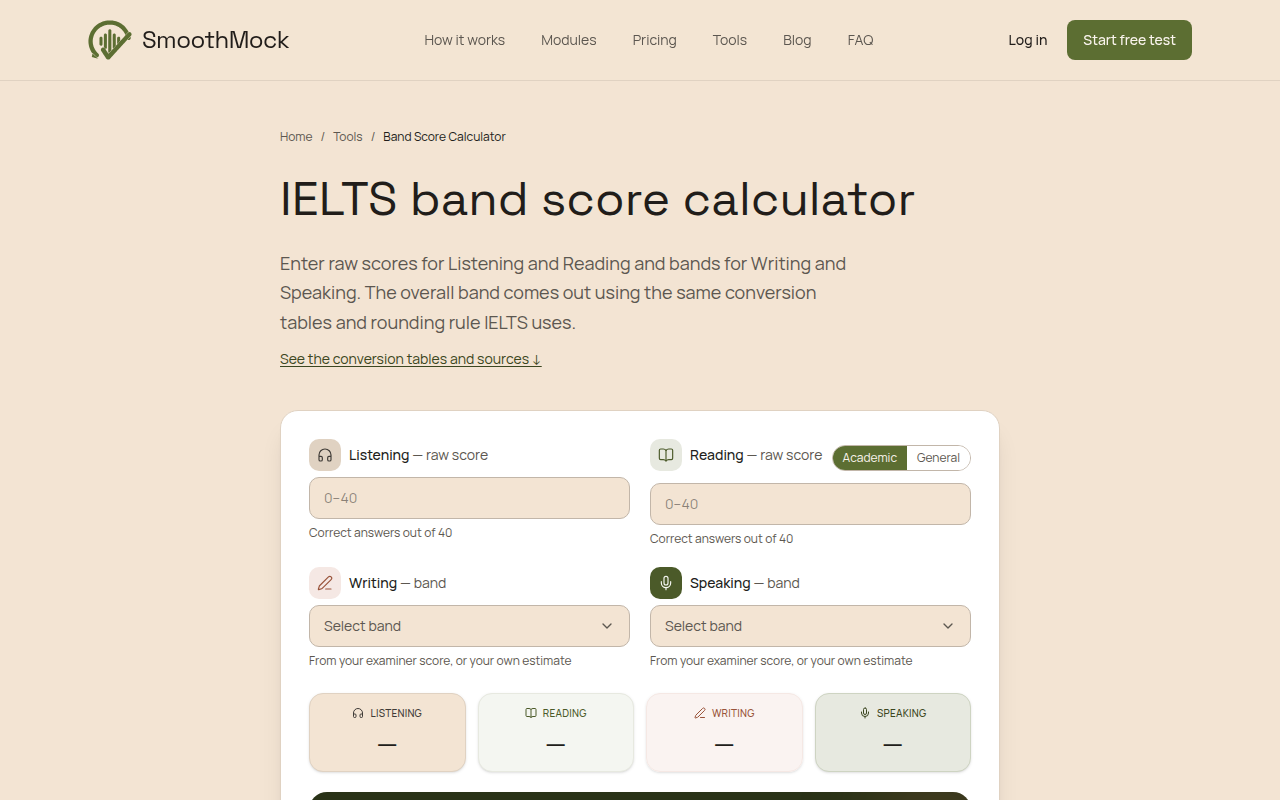
The band score calculator shows how your Reading band combines with the rest. You enter raw scores out of 40 for Listening and Reading, switch Reading between Academic and General, and pick bands for Writing and Speaking. It converts them with the same tables and rounding rule IELTS uses: the overall band is the average of the four sections, rounded to the nearest half band.
Drill your weak types
Full papers are slow and tiring, so once you know your weak types, work on them separately.
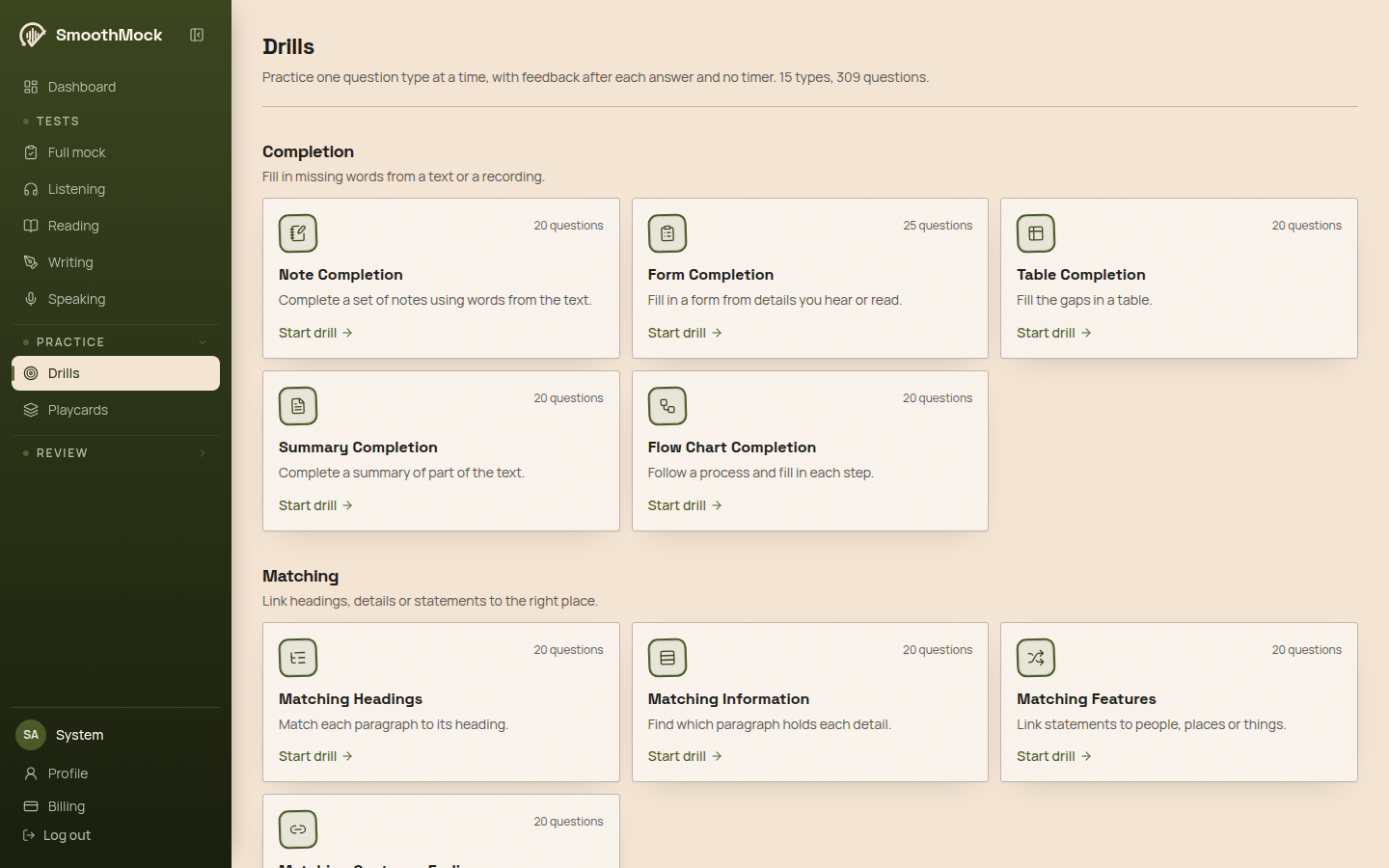
Open Drills in the sidebar, under Practice. Drills are grouped by what the question asks you to do: completion, matching, choose or decide, and labelling. Each drill covers one question type, gives feedback after every answer and has no timer, so you can slow down and see why an answer was right.
About 20 minutes a session is plenty. Afterwards, go through each wrong answer and sort it with the same three reasons as in your log. The fixes differ. If you couldn't find the paragraph, you need more scanning practice. If you chose badly, take more care with paraphrase and with the Not Given rule. If you ran out of time, change your pacing.
Plan your time by question, not by passage
Sixty minutes for 40 questions is 1.5 minutes each, but the questions aren't equal. Short completion questions go quickly once you've found the paragraph, while matching headings and multiple choice take longer.
Passage 1 is usually the most factual and Passage 3 the hardest and most argument-driven, so aim to finish Passage 1 quickly and bank the time. If a question has cost you two minutes, write your best guess and move on, and come back only if time is left. Within a passage, take the quicker question types first and leave the slow ones for the end.
Test any plan on two or three timed papers before you trust it. The right split depends on how fast you scan, and that's personal.
Fix the mistakes that keep coming back
After a few papers, the same mistakes repeat. Open Graded papers in the sidebar, under Review. The "Where you lose marks" section ranks the root causes behind your lost marks, most frequent first. SmoothMock sorts every mistake into one of six causes: distractor traps, vocabulary gaps, grammar errors, missed paraphrases, careless or time-pressure slips, and off-topic answers. Each cause has a "How to fix this" note and a "Practice this" link.
In Reading, the common ones usually mean this:
- Missed paraphrases: the passage restated the idea in different words. Before you scan, think of a couple of ways it might rephrase the question, as in the beekeeping example.
- Distractor traps: a plausible option pulled you off the right one. Read the whole sentence around each option before you choose.
- Careless or time-pressure slips, such as writing three words where the limit is two: underline the word limit before each question set, and keep a few minutes at the end to check.
- Vocabulary gaps: a key word blocked you. The Playcards page in the sidebar is a flashcard deck for building vocabulary. Add words from papers you've done, not from random lists.
Pick the cause at the top of the list and work on it for a week before you move to the next.
A weekly routine
For someone with about an hour a day:
- Monday and Wednesday: a 20-minute drill on your weakest type, then review against your log.
- Tuesday and Thursday: one passage under time, using the find-the-answer method, then check every answer for why it went wrong.
- Friday: a drill on your second weakest type.
- Weekend: one full 60-minute paper, a look at the breakdown, and an update to your log.
One full paper a week is enough. Drills build skill, full papers build stamina, and a full paper every day tends to tire you without teaching you more. When a type stops being your weakest, move to the next.
If you're also working on the other skills, the matching guides are Listening, Writing and Speaking.
Frequently Asked Questions
How many questions are in IELTS Reading?
There are 40 questions across 3 sections, and you have 60 minutes. Academic and General Training use the same number of questions, but the texts and the score conversion differ.
Is there negative marking in IELTS Reading?
No. Each correct answer receives 1 mark and nothing is taken away for a wrong one, so guess rather than leaving a question blank.
How many correct answers do I need for Band 7 in Academic Reading?
On average, 30 to 32 out of 40, according to IDP's conversion table. The exact number varies slightly by test.
Does General Training Reading need the same raw score?
No. It needs more correct answers for the same band, for example 34 to 35 for a 7.
How should I split my time across the three passages?
There's no fixed split. Aim to finish Passage 1 faster, and test your own timing over two or three timed papers.
How do I use SmoothMock for Reading?
Take a timed paper, open the question-level result, drill your weakest question type under Drills, and check Graded papers for repeating mistakes.
Sources
- IELTS Academic Reading format (ielts.org)
- How IELTS is scored in detail (ielts.org)
- IELTS Reading band score conversion, Academic and General Training (IDP)
Facts about the test format and scoring were checked against these sources on 1 October 2026. The sample passage and statements in the worked example and the question-type section are invented for illustration, and the advice on technique and pacing is the author's own.
Ready for your baseline? Take the Reading practice test, then come back to the result section.
Ready to put this into practice?
Start a free full-length IELTS mock test — AI graded in minutes.
Start your free test →